Reno, NV Air Quality Index (AQI) Today
LIVERight now: Reno is at 39, good.
Is the air safe to breathe in Reno today?
Go
Normal outdoor plans. No change needed.
Short & unloaded
A 20-minute dog walk, not a 2.5-hour run. Keep it brief and easy.
Don’t go
Move it indoors. Above 200 that becomes everyone, not just sensitive groups.
Duration and intensity are two separate dials
| Under 20 min | 20–60 min | Over an hour | |
|---|---|---|---|
| Easy | Go | Go | Go |
| Moderate | Go | Go | Go |
| Hard | Go | Go | Go |
Where people actually draw the line
- 60 Asthmatic runnerone runner’s own 156-run log
- 75–100 Daycare / schoolWA 75/80, MN 100 — confirmed; most states not studied
- 100 Parentcommunity-reported, escalating at 150 and 200
- 110 Runnercommunity-reported
If you’re staying in, filter the room you’re actually in
Dominant pollutant
O3
UV index
—
Forecast
—
That color and number are today’s read on Reno air quality. What they’re actually deciding is smaller than the headline: the run along the Truckee River, the kid’s soccer practice, whether the windows stay open tonight. This page tracks the air quality Reno has actually breathed over the past month, not just the one figure updating above. Set your own line and get told when Sierra smoke pushes past it.
Reno’s last 30 days, not just today
One reading says nothing about the shape behind it. This page rebuilds the air quality Reno saw over the trailing 30 days, from the same hourly AQI feed as the number above. It also carries a running count of days above AQI 100 in the last 12 months. Search interest for air quality Reno runs a median month of around 800. That’s near the bottom of this project’s build list, tied with Albuquerque and ahead of eight lower pages. It still earns its own page, and the reason is the shape of the year, not the size of it. IQAir and AccuWeather hand you today’s number and stop there. Neither shows whether a given week is typical, or the one loud stretch that actually drives the search.
Why is it hazy in Reno today?
Reno’s haze mostly arrives from somewhere else. Fires in the Sierra Nevada and further into California send smoke east, over the mountains and into the Truckee Meadows. Three things can also make the sky look worse than the number: 24-hour averaging, smoke sitting aloft, or a distant station.
That’s the valley Reno and Sparks sit in. The AQI’s 24-hour average dilutes a rough afternoon across the calmer hours around it. Smoke can also sit aloft above the ground-level monitor doing the measuring. A commenter on r/Seattle described the same physical gap during a separate regional smoke event: “Air sensor on ground, smoke up high (for now).” Or the nearest working station is miles off, standing in for a metro the smoke hasn’t reached evenly. None of that makes the haze fake. Sierra smoke, a valley lid, a distant station has all six causes.
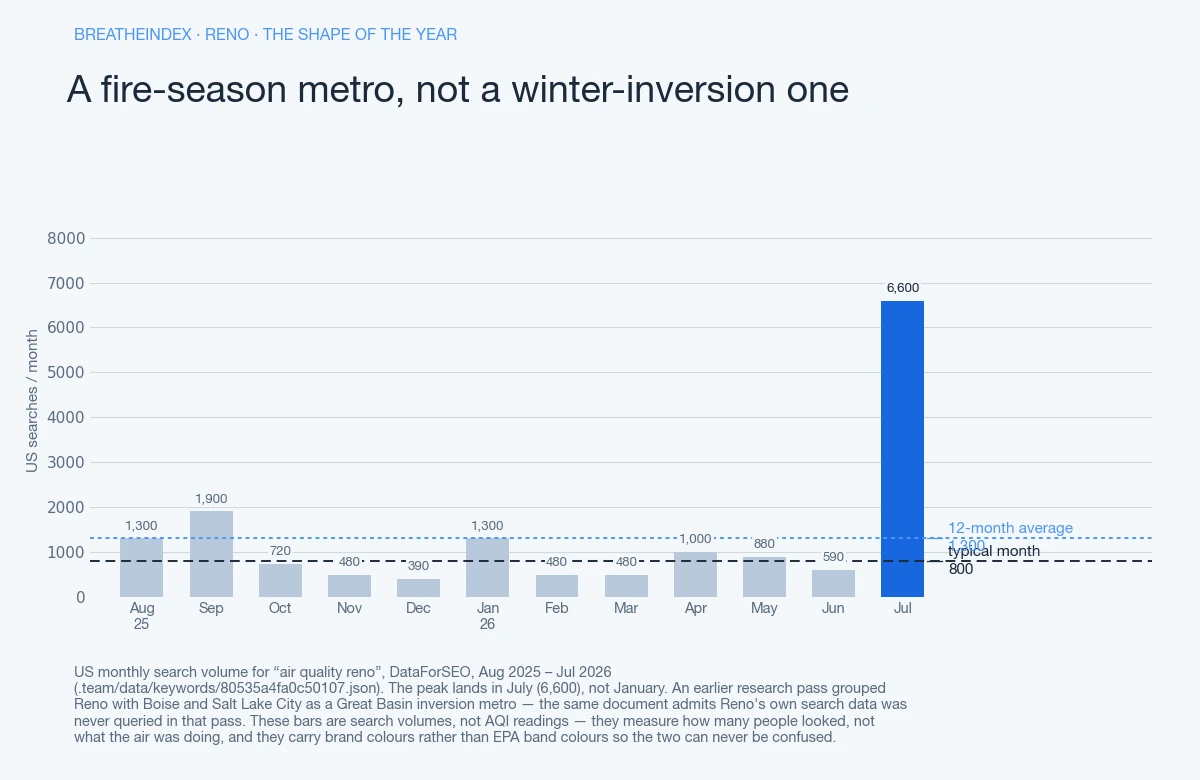 A fire-season metro, not a winter-inversion one. Search volumes, not AQI readings — bars are neutral blue-grey with the peak month in accent blue, never EPA band colours, so demand data can never be read as a measurement of the air.
What is causing the bad air in Reno?
Two mechanisms drive most of Reno’s bad-air days, and they’re not evenly sized. Sierra wildfire smoke does most of the work. Fine particulate matter (PM2.5) is carried east from California and Nevada fires on the same summer wind patterns, most years. Wind-blown dust off the high desert is the second cause: coarser PM10, common on dry, gusty days with nothing burning at all.
A smaller, cold-season mechanism exists too. The Truckee Meadows basin can trap cold air on a still winter night, the way a mountain valley pools pollution elsewhere. It’s a real mechanism, but the minority contributor here, not the dominant one. No Reno-specific community account of any of the three turned up in the material reviewed for this page.
Is the air safe to breathe in Reno today?
Reno’s haze mostly travels in from somewhere else. Fires in the Sierra Nevada, and further into California, send smoke east over the mountains into the Truckee Meadows, the valley Reno and Sparks share. Once it’s there, the valley holds it the way any bowl-shaped terrain does. Go on a clean reading. Short and unloaded: the short trail loop instead of the full ridge hike. Don’t go past that.
EPA marks everyone as warned starting at 151, Unhealthy, and 201 to 300, Very Unhealthy, restates that warning more seriously rather than adding a group. Past roughly 200, imported smoke or not, the plan moves indoors.
What AQI should you stay inside?
Whose threshold matters here? A runner on r/Marathon_Training answers 110: “I’ll run in up to 110 because…error bars.” An asthmatic runner answers 60, from a 156-run log against AQI — “my lungs struggle regardless of how well I’ve trained,” even with EPA calling nothing under 100 unhealthy, success sliding from 87% under 50 to 42% between 50 and 70 to 12% past 70. Parents online answer somewhere near 100.
Smoke rolling in over the Sierra Nevada, not a local source, is what actually moves the Truckee Meadows reading — and it drags every number above down roughly one EPA band once it settles in. The EPA calls it the 101–150 band, Unhealthy for Sensitive Groups — attributed wording, not a personal ruling.
No Nevada rule sets an AQI cutoff for schools or daycares, at least not one confirmed in the material this project reviewed. Washington and Minnesota are the two states that have one. Washington’s and Minnesota’s published numbers has both.
The indoor default: a portable HEPA purifier, or a $130 Corsi-Rosenthal box sized for a 12x14 bedroom, per one community build. A whole-house MERV-13 filter is a bigger step — a licensed tech needs to check static pressure before that swap, imported smoke or not. What to set up indoors, and what to skip covers the rest.
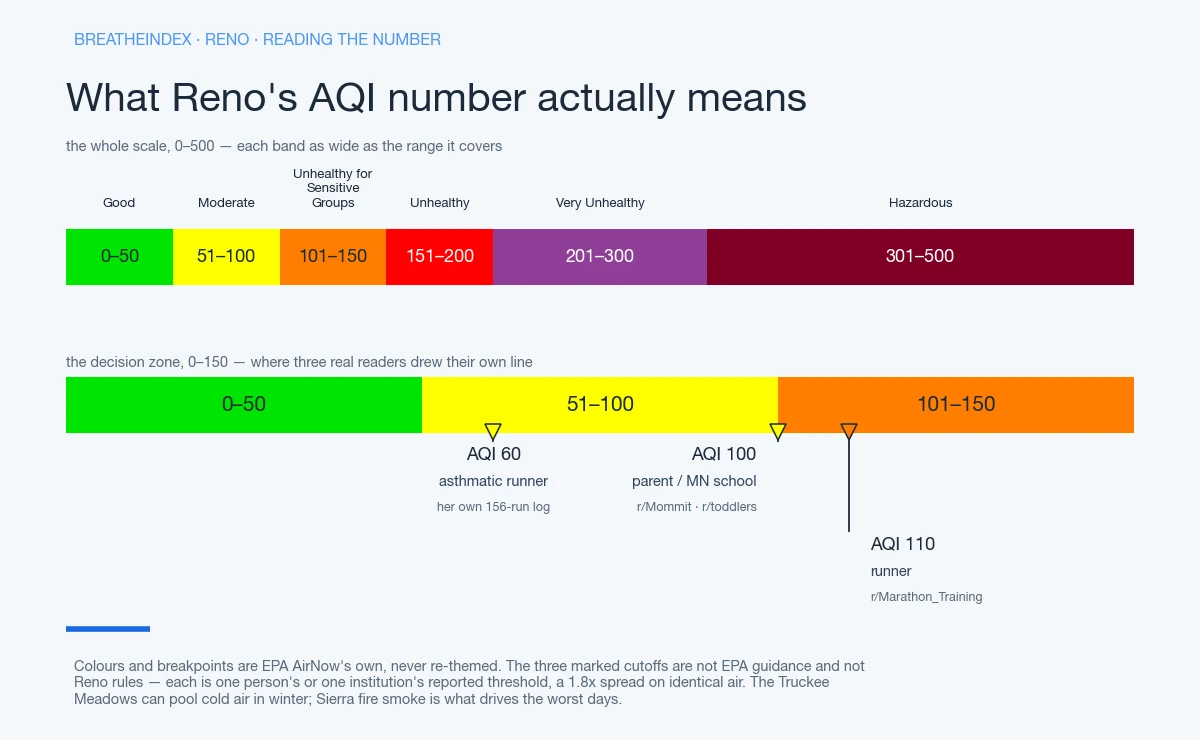 EPA AirNow’s own colours and breakpoints. The three marked cutoffs are not EPA guidance and not Reno rules — each is one reader’s or one institution’s own line.
Why our number may not match what you are seeing and smelling
The mismatch between Reno’s sky and its number runs two directions. A smoky sky with a calm number usually means smoke sitting aloft above the monitor, or the 24-hour average diluting a rough afternoon. A clear, still day with a moderate reading usually means ground-level ozone, formed when sunlight cooks vehicle exhaust — invisible and odorless. Neither direction means the number is wrong; it means the number and the senses are measuring different things.
One commenter on r/Denver flagged the identical blind spot: “spreading awareness about ozone is tough because it’s mostly invisible and odorless. Telling people they’re breathing in a toxic invisible gas is a sure way to kill the vibe. But it must be done!”
That’s the monitoring station behind today’s reading — its distance from the metro centroid, and the nearby PurpleAir sensor count. A station miles off under-reports whichever side of the Truckee Meadows sits farthest from it. How far the station sits from the Truckee Meadows you’re in is set out in full.
Does Reno’s air get worse in winter?
Some, but less than summer does. Reno’s own winter search-interest ratio runs around 39% of the rest of the year. The actual peak lands in July, not January, making Reno a fire-season metro first, not a winter-inversion one. That’s a different shape from Salt Lake City’s genuinely bimodal year, where January and June both post the same measured 27,100 in search interest.
This project’s own keyword research flags exactly why the mix-up happened. An earlier pass grouped Reno with Boise’s Treasure Valley, Sacramento’s winter lid and Spokane’s fire-season peak as Great Basin inversion metros. That same research document admits Reno’s own search data was never actually queried in that pass. This page follows the measured shape, not the inherited tag. A real physical mechanism does exist here in winter. The Truckee Meadows basin can trap cold air on a still, calm night, the same kind of pooling that traps a mountain valley’s pollution elsewhere. It just isn’t what drives the year’s worst air in Reno.
FAQ
What’s the air quality forecast for Reno tomorrow?
Wind off the Sierra can shift a forecast within hours. Treat it as a direction, not a lock — recheck the morning of.What’s the UV index in Reno today?
UV runs on its own scale, separate from AQI. A clear, low-AQI day is often the highest-UV day of the week, so a good air quality reading isn't a reason to skip sunscreen.Who has the worst air quality in the US right now?
See how Reno ranks today against every tracked city. Its rank moves hardest in July and during active Sierra wildfire smoke, not in winter.
What is in the air in Reno right now?
That's today's specific reading. Sierra and California wildfire smoke (PM2.5) drives most bad-air days here; windblown high-desert dust (PM10) is the other recurring cause.Why does it smell like smoke outside in Reno?
Wildfire smoke smell means burning vegetation, almost always drifting in from a fire many miles west, over the Sierra. If a specific fire is active, Whether the smoke is aloft or on the ground answers that first.
Where this reading comes from
Reno-Sparks, about miles from the metro centre, with nearby sensors.
The last 30 days in Reno
0 of the last 30 days were above AQI 100.
Questions people ask
What AQI should you stay inside?
Is it safe to exercise outside today?
Why does another app show a different number?
Updated