Some links below are affiliate links: if you buy through them we may earn a commission, at no cost to you. We don’t test products and we don’t sell purifiers. Full disclosure.
Some links on this page are affiliate links. If you buy through one, we may earn a small commission at no extra cost to you. We don't test air purifiers ourselves. The picks and prices below come from what the community has actually built, bought and measured. [Full disclosure](/affiliate-disclosure/).
A cheap indoor air quality monitor answers one question your nose can’t: is this room’s air actually bad, or does it just feel stuffy? EPA, NIEHS, OSHA and the American Lung Association already define indoor air quality end to end. This page skips that part. It goes straight to what those pages don’t cover. Which monitor is worth the money. What MERV rating is safe for your specific furnace. Whether the purifier already sitting in your bedroom is doing anything at all.
Search interest here doesn’t move the way the smoke-driven side of this site does. Indoor air quality as a bare phrase peaks in September, not winter. That’s a 69% winter ratio — the opposite of a cold-season term. But indoor air quality monitor, the entry point for this page, runs 107%. November averages 14,800 monthly searches against April’s 5,400. That’s a real 2.7x swing, not a manufactured one. This page is scoped to the part that’s actually counter-seasonal: the monitor, the filter, the box fan. Not a rewrite of what indoor air quality is.
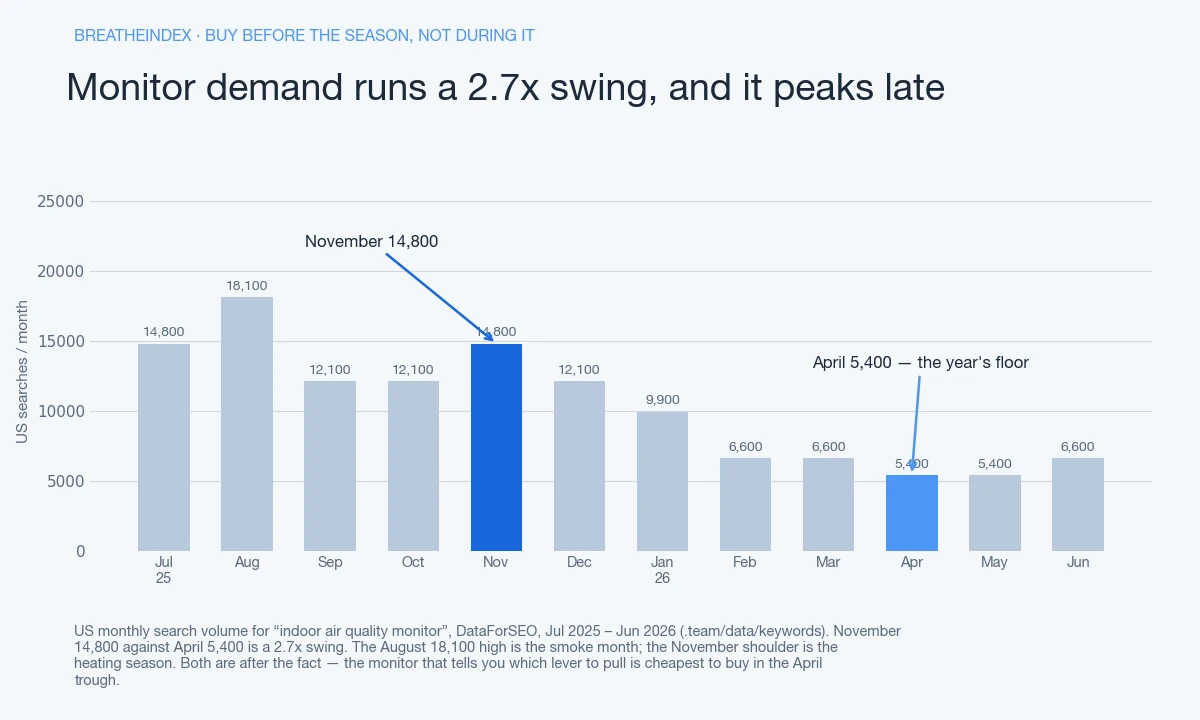 Monitor demand peaks after the smoke and after the heating season starts. The April trough is when the device is cheapest to buy and least useful to panic over. Search volumes, not AQI readings. November is the bar in accent blue, April the lighter blue; the rest are neutral blue-grey.
How do I monitor the air quality in my home?
Buy the indoor air quality monitor before the purifier, not after. That’s the order the community actually follows, and it inverts the funnel most sites assume. One 898-upvote r/AirQuality post, from July 2026, put the whole logic in five words: “air good or air bad?” The poster’s own cheap IKEA monitor did that one job well. It flagged a problem before it was visible or smelled, since wildfire smoke can arrive faster than a forecast predicts. A monitor also closes the loop on whatever you buy next. “Another reason to have an air quality monitor: you will actually know if your purifier is cleaning the air!” Without one, a purifier is a guess running in the corner of a room.
On price, one commenter pointed buyers toward monitors available for under $100. A step up, an Atmotube VOC monitor ran “$150 ish on Amazon” per another. A standalone IAQ test kit is a cheaper, one-time alternative — a single gut-check reading rather than an always-on device. Most monitors pair a PM2.5 sensor with a VOC sensor, a CO2 ppm reading, and humidity. None of that is a mold-spore count. Persistent humidity above the usual 30-50% guidance, paired with a musty smell, is a reasonable prompt to investigate further, not a diagnosis.
Government monitors update roughly once an hour. PurpleAir’s denser network refreshes closer to every ten minutes. That speed comes at the cost of needing its own calibration awareness — the same tradeoff this site’s own methodology runs into. Neither wins outright on “most accurate.” They answer different questions at different speeds.
What should you actually buy, in order?
The community builds its own price ladder, cheapest fix first. It rarely starts with a purifier at all.
| Price | What people buy | Why |
|---|---|---|
| $0 | Close windows, recirculate in the car | Free, works immediately |
| $15–30 | Cabin air filter swap | Smoke events chew through a car filter too |
| $20–40 | P100 respirator | For time spent outside |
| ~$39 | Compact single-room HEPA unit | Cheapest dedicated indoor purifier |
| ~$130 | Corsi-Rosenthal box (DIY) | Cheap, cannot damage an HVAC system |
| $100–150 | Mid-size HEPA console | Whole-room coverage |
| $3,000 | Commercial-grade unit | Small business / heavy use, unresolved value |
At $0: close the windows, and set the car to recirculate during a bad-air drive. At $15–30: a cabin air filter swap. The same 898-upvote thread flagged this specifically, since a smoke event chews through a car’s filter too. At $20–40: a respirator, P100-rated in the specific recommendation from that thread’s top reply. Around $39, one r/Asthma reply pointed to a compact unit with a HEPA filter, for a single bedroom: “It was only 39 bucks.” At about $130, one builder documented a Corsi-Rosenthal-style box, itemized: a 20-inch box fan, four MERV-13 filters, a sheet of plywood. At $100–150, a mid-size HEPA console from Costco. One owner: “I cannot sleep without it now.” At the very top, one small-business owner spent $3,000 on a commercial-grade unit. A reply flagged the obvious question — “That’s pricey, worth it?” The honest, unresolved answer a week in: “Don’t know.”
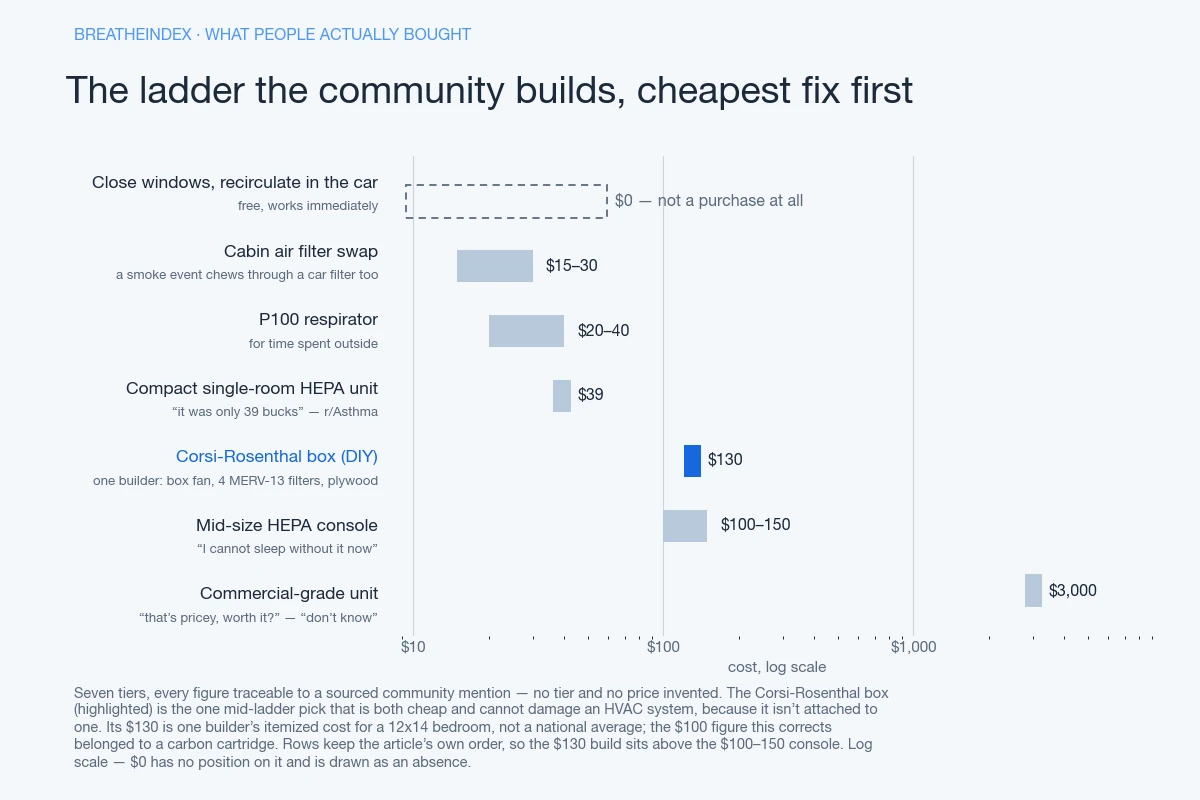 Seven tiers, every figure traceable to a sourced community mention. The Corsi-Rosenthal box is the one mid-ladder pick that is both cheap and cannot damage an HVAC system, because it isn’t attached to one. Its rung is the one bar drawn in accent blue; the rest are neutral blue-grey.
The Corsi-Rosenthal box sits in the middle of that ladder for a reason. It’s the one recommendation that’s both cheap and can’t damage an HVAC system, because it isn’t attached to one. We don’t have a sourced CADR figure for a CR box in our data, so none is given here. The honest answer is “we don’t have that number,” not an invented one. What’s sourced is the build cost and the parts list. A dedicated community (r/crboxes) documents variations, and a UC Davis walkthrough — the same one the 898-upvote poster above linked directly — is a starting point for anyone on a tight budget mid-event.
What MERV rating should I use?
This is where the internet disagrees with itself, and the disagreement matters more than either side’s confidence. Don’t take a flattened answer here.
In one 487-upvote r/hvacadvice thread, a homeowner had two zones struggling to hold temperature. Their HVAC tech’s diagnosis: drop the high-restriction filters back to MERV 5–8. The fix worked. The system normalized. That’s the case for caution, and it’s real. But the thread’s two top replies push back hard. “These filters are not anywhere near as restrictive as HVAC techs just blindly assume,” argued a commenter who says they helped design the nonwoven media used in Filtrete filters. They pointed to standardized testing behind every one sold. Another reply, at 214 upvotes, went further: “MERV isn’t an airflow rating. Never has been.” They cited independent state testing showing pleated Filtrete filters running the highest airflow of the group tested — the opposite of the assumption that higher MERV always means more restriction. Further down the same 387-comment thread, another commenter reported the reverse of the fix above. Their coils kept freezing after switching to a high-restriction filter. Dropping to MERV-8 solved it, on their system specifically.
Nobody in that thread settles which side is right for a given house, and this page won’t manufacture a settlement either. What holds across every account: MERV rating alone doesn’t tell you whether a specific filter, in a specific system, will choke your airflow. The only way to know is to check. A licensed tech can measure your system’s actual static pressure before and after a filter swap — a cheap test against a burned-out blower motor. Search interest backs the caution up on its own. Merv 11 vs merv 13 runs close to flat year-round (101%, on limited data). Furnace filter merv rating skews toward winter instead (129%). People hit this decision when a filter actually needs replacing, which leans toward heating season without being confined to it.
Until you’ve had that check done, default to a portable HEPA purifier or the Corsi-Rosenthal box above. Neither one touches your HVAC system’s airflow, because neither one is inside it.
Why is PM2.5 high in my house in winter specifically?
Closing the windows solves one problem and starts another. Once outside air stops circulating through, whatever’s generated inside has nowhere to go — your home’s air exchange rate drops right when indoor sources are working hardest.
Cooking is one of the largest sources, and it’s active every day, not just during a smoke event. “Cooking is a big source of indoor air pollution, especially frying and toasting,” one commenter wrote. A kitchen hood pulls in more outdoor air while it runs, worth it anyway since the alternative is worse. Heating season adds a second source most people don’t think about. Any gas appliance, any wood stove, any fireplace is burning something indoors — in a house now sealed tighter than it was in July. New furniture and fresh paint add a third, slower source: VOCs like formaldehyde, off-gassing regardless of season but with nowhere to vent once the windows stay shut. A fourth, smaller source showed up in one 1,000-upvote thread: a filter that got noticeably dirty in just two months, on a system with no pets and no reported smoking. The top reply’s read was candles and wax warmers.
None of this means never close the windows. During an actual smoke event, sealing up is still the right call. The PM2.5 outside at AQI 100+ outweighs the CO2 and VOC buildup from staying sealed. The tradeoff is just worth knowing about once the event passes and winter settles in for good.
Was buying an air purifier a waste of money?
This is the question that arrives after the purchase, not before it. One buyer, mid-wildfire-event with a limited store selection, asked it plainly: “Just now learning that air purifiers often aren’t as good as they claim to be. Was this a complete waste of money?” The purifier they’d grabbed wasn’t on anyone’s smoke-specific recommended list.
The monitor from the section above is exactly how you’d actually answer that, instead of guessing. Two owners in our sources ran a before-and-after this way. One measured PM2.5 around 30 µg/m³ in a drafty apartment before running two HEPA units. It dropped to under 2 in the bedroom and 5–10 in the open living area afterward. Another ran a smoke test on a closed bedroom, watching two separate monitors track the drop from the hundreds down to single digits over about 25 minutes. Neither is lab-grade testing, and one commenter said as much in reply. But both are the same test anyone can run with an affordable monitor and some patience. If your own numbers don’t move after an hour, that’s useful information too — wrong room size, a saturated filter, or a unit that was never a good match for what’s in your air.
The three levers, in the order they’re worth pulling
EPA’s own framework for indoor air names three levers: source control, ventilation, filtration. Everything above maps onto it. Source control is the cooking hood, the wax warmer left unlit, the gas stove swapped for electric when it’s time to replace one. Ventilation is the windows — open them when the outdoor number allows it, seal them when it doesn’t. Filtration is the last lever, not the first. An indoor air quality monitor is the cheapest way to find out which of the other two actually needs pulling. Then the purifier or CR box handles what’s left. Reach for filtration first and you’re buying a $130 box to fix a problem a closed damper or an unlit candle would have solved for free.
FAQ
What are the symptoms of poor indoor air quality?
Headaches, fatigue and breathing irritation are the EPA’s short list. None is unique to bad air on its own. That’s exactly why a monitor is more useful than guessing from symptoms alone.
How do I tell if the air in my house is making me sick?
Match symptoms to a monitor reading over a few days, not a single afternoon. A pattern — worse after cooking, worse with the windows shut, better outdoors — points at an indoor source a single snapshot reading can’t.
What is a good indoor air quality reading?
EPA doesn’t publish an indoor-specific AQI scale the way it does outdoors. As a practical anchor, PM2.5 in the low single digits (µg/m³) is what purifier owners in our sources report once their unit is actually working. A reading in the 30s is closer to what one drafty apartment measured before a fix.
Which air quality monitor is the most accurate?
No single answer, and this page won’t rank one. Official monitors are validated but sparse and hourly. Denser consumer networks like PurpleAir update faster but need their own calibration awareness. The methodology page covers that tradeoff in full.
How often should I change my furnace filter?
It depends on the filter and the system, not a fixed date. One commenter runs a high-airflow MERV 11 monthly. The fix in the 487-upvote thread above was tied to a symptom — a struggling zone — rather than a calendar.
Can air quality sensors detect mold?
Not directly. Consumer monitors track PM2.5, VOCs, CO2 and humidity, not mold spores. Keeping indoor humidity in the standard 30–50% range is the usual guidance for limiting mold growth in the first place, separate from anything a monitor reads directly.
Is radon a concern here too?
Radon levels are a separate, invisible-gas measurement no PM2.5 or AQI monitor tracks. Testing for it needs a dedicated radon kit, not the tools covered on this page. EPA’s radon guidance is the place to start.
What it actually costs
- $0 Close the windows, run the fan on recirculatecommunity practice
- $15–30 Cabin air filter for the carr/AirQuality, 20–80% reduction reported
- $20–40 Box fan on its ownmoves air, filters nothing
- $39 Small HEPA unit (Levoit-class)community-reported price
- $130 Corsi-Rosenthal box, DIYone builder, 12×14 ft bedroom START HERE
- $100–150 Mid HEPA unit (Winix-class)community-reported price
- $3,000 Whole-house medical-grade (IQAir-class)community-reported price
MERV-13 in whole-house HVAC: the community disagrees
Reported problem
Top replies disagree
Our default is a portable HEPA unit or a Corsi-Rosenthal box. If you want MERV-13 in a whole-house system, get a static-pressure check and confirm your blower is rated for it first. Nobody in that thread could predict another person’s system, and neither can we.