Milwaukee, WI Air Quality Index (AQI) Today
LIVERight now: Milwaukee is at 43, good.
Is the air safe to breathe in Milwaukee today?
Go
Normal outdoor plans. No change needed.
Short & unloaded
A 20-minute dog walk, not a 2.5-hour run. Keep it brief and easy.
Don’t go
Move it indoors. Above 200 that becomes everyone, not just sensitive groups.
Duration and intensity are two separate dials
| Under 20 min | 20–60 min | Over an hour | |
|---|---|---|---|
| Easy | Go | Go | Go |
| Moderate | Go | Go | Go |
| Hard | Go | Go | Go |
Where people actually draw the line
- 60 Asthmatic runnerone runner’s own 156-run log
- 75–100 Daycare / schoolWA 75/80, MN 100 — confirmed; most states not studied
- 100 Parentcommunity-reported, escalating at 150 and 200
- 110 Runnercommunity-reported
If you’re staying in, filter the room you’re actually in
Dominant pollutant
PM2.5
UV index
—
Forecast
—
That color and that number are today’s read on Milwaukee air quality. Decide by the color first, the number second. The actual question underneath it is smaller: the lakefront run, the county park cookout, whether tonight’s windows stay open. This page tracks the air quality Milwaukee has actually breathed over the past month, not just the single figure sitting above. Pick your threshold and get a message when the lake air crosses it.
One flood a year, eleven quiet months in Milwaukee
Search interest for “air quality milwaukee” averages 8,100 a month across the trailing year. The typical month runs only 535, below Madison’s 720. One month, July 2026, spiked to 74,000. That’s the same Canadian smoke plume that pushed neighboring Madison to 90,500 and Chicago’s own AirNow reading to 742 AQI that same week. That’s a 15.1x gap between average and typical month, the widest ratio measured in this corridor so far. This page rebuilds the air quality Milwaukee actually breathed over the past 30 days, from the same hourly feed as the reading above. It also carries a running count of days above AQI 100 in the last 12 months — the shape IQAir, AccuWeather and Wisconsin’s own monitor grid never show, because none of them track more than today’s single number.
Why is it hazy in Milwaukee today?
Milwaukee sits on Lake Michigan’s western shore. An onshore lake breeze can hold ground-level ozone right along the shoreline on hot, calm days, instead of letting it disperse inland. A jogger on the lakefront path can breathe worse air than someone a few miles inland on the same afternoon. Three more things can make the sky look worse than the number, or the reverse: 24-hour averaging, smoke sitting aloft, or a distant station.
The wider mechanism is the Upper Midwest lake corridor Milwaukee shares with Chicago, Madison and Minneapolis — mostly open, wind-scoured terrain. The exception is a Canadian wildfire plume, which blankets the whole corridor regardless of local geography. The AQI’s 24-hour average dilutes one bad afternoon across the day’s twenty calmer hours; smoke from a distant fire can sit aloft above the monitor; or the nearest working station sits miles from wherever you actually are. None of that makes a hazy sky fake, or a clear one trustworthy — one number averages one location, not your block. Lake air, drifting smoke, and a 24-hour average covers each cause in turn.
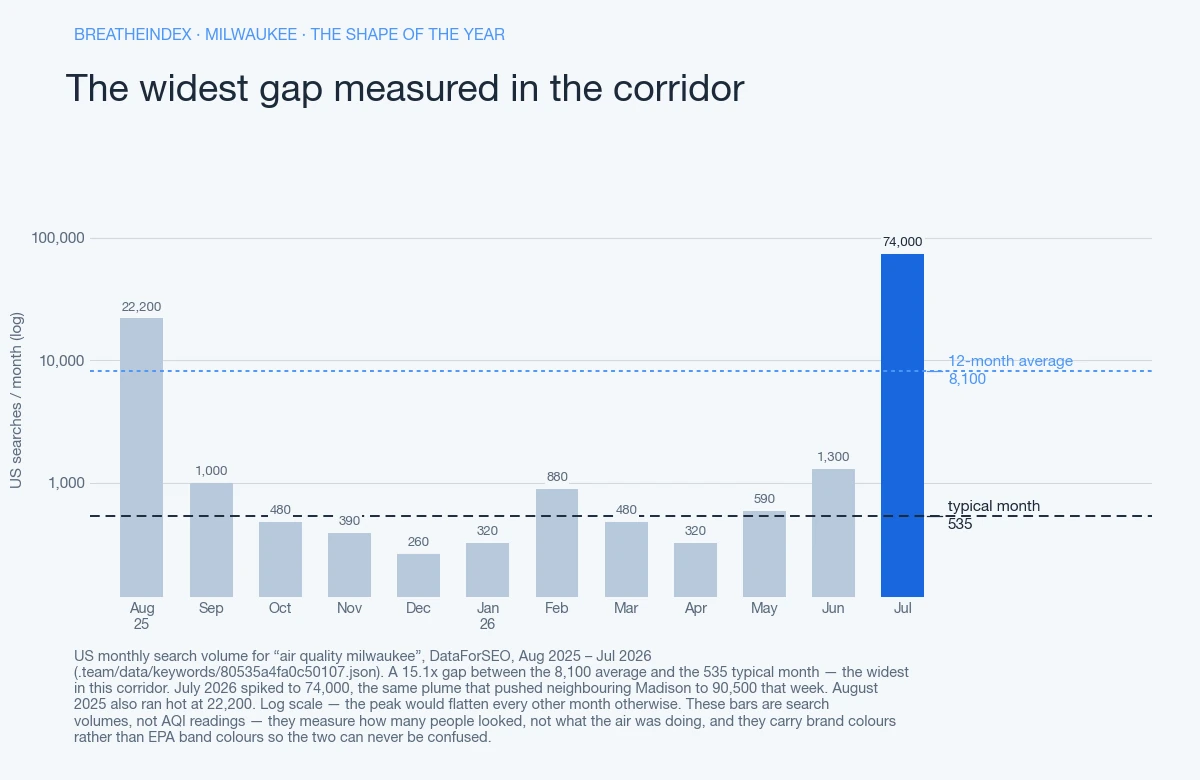 The widest gap measured in the corridor. Search volumes, not AQI readings — bars are neutral blue-grey with the peak month in accent blue, never EPA band colours, so demand data can never be read as a measurement of the air.
What is causing the bad air in Milwaukee?
Two mechanisms trade off through a Milwaukee year. Ground-level ozone builds on hot, still summer afternoons, worse right along the lakefront than a few miles inland — invisible and odorless. PM2.5, fine particulate matter, dominates the rest of the year. Traffic and industry drive it normally, with a Canadian wildfire plume increasingly able to override both readings within hours.
That’s the wildcard behind the 15.1x average-to-typical gap: one smoke week outweighs eleven ordinary ones. The FAQ below carries today’s live read on which pollutant is actually driving the number.
Is the air safe to breathe in Milwaukee today?
Milwaukee’s lakefront can read worse than a spot a few miles inland on the same afternoon. An onshore breeze off Lake Michigan holds ground-level ozone right along the shoreline instead of letting it disperse. Go, unchanged, on Good or Moderate air. Short and unloaded: the short bike ride instead of the group ride along the lakefront path. Don’t go past the middle band.
EPA’s everyone-warning starts at 151, Unhealthy. 201 to 300, Very Unhealthy, is that same warning escalated, not a new group added. Past roughly 200, the lakefront path and the inland route agree: stay in.
What AQI should you stay inside?
Minnesota sets a real school threshold — a parent there put it at 100. Washington sets 80. Wisconsin sets neither — a licensing gap one Wisconsin parent ran into directly. Her daycare kept kids outside with the AQI near 150. She was told “the state only requires them to keep them inside when it’s too hot or too cold.”
A commenter worked in Wisconsin schools and daycares for almost a decade. They explained why that holds up: “I don’t think there’s anything in the state licensing regulations about air quality,” they wrote, “however, the licensing regulations are very clear about children being given outside time.” Why Wisconsin leaves the number to the provider has all three.
The lakefront’s own onshore-breeze ozone shifts personal thresholds the same way smoke does. Right along the shoreline path, treat your usual number as about one EPA band lower. The EPA band covering it is 101–150, Unhealthy for Sensitive Groups, an agency label rather than a personal verdict.
Adults set their own numbers regardless of the source. On r/Marathon_Training, one runner wrote: “I’ll run in up to 110 because…error bars.” One asthmatic runner logged 156 runs against AQI and set a personal cutoff at 60. Past it, “my lungs struggle regardless of how well I’ve trained,” despite EPA calling nothing under 100 unhealthy. Their log: 87% of runs under AQI 50 went fine, 42% between 50 and 70, just 12% above 70.
Indoors, default to a portable HEPA purifier or a Corsi-Rosenthal box, priced by one builder at around $130 for a 12x14 bedroom. Skip the whole-house MERV-13 swap unless a licensed tech has checked the system’s static pressure first. Winter indoor PM2.5, and where it comes from picks it up from there.
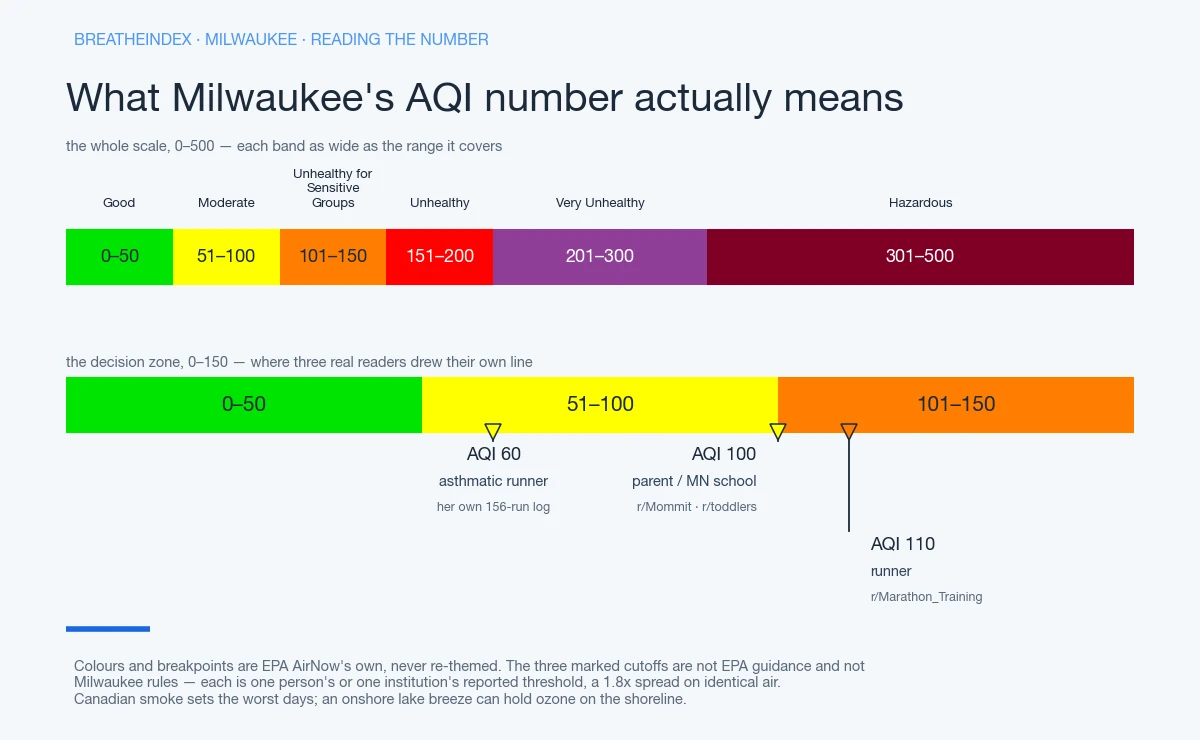 EPA AirNow’s own colours and breakpoints. The three marked cutoffs are not EPA guidance and not Milwaukee rules — each is one reader’s or one institution’s own line.
Why our number may not match what you are seeing and smelling
The mismatch runs in both directions here. A clear sky with a bad number usually means ground-level ozone, worst right along the lakefront in summer. It’s invisible and odorless, with no way to smell a safe read. A hazy-looking sky with a calm number is usually a 24-hour average diluting a rough afternoon. Or smoke sitting aloft above the monitor, well above the shoreline breeze.
Neither direction means the number is wrong. It means the number and your senses are reading different things.
That’s the station behind today’s reading — its distance from downtown Milwaukee, and the nearby PurpleAir sensor count. A station miles off under-reports whichever side of the metro sits farthest from it, lakefront or inland. Why lakefront and inland can read differently on the same day goes through it.
FAQ
What’s the air quality forecast for Milwaukee tomorrow?
Lake breeze direction and any incoming plume can shift this within hours. Treat it as a direction, not a lock — recheck the morning of.What’s the UV index in Milwaukee today?
UV runs on its own scale, separate from AQI. A clear, low-AQI day can still be the highest-UV day of the week, so a good air quality reading isn't a reason to skip sunscreen.Who has the worst air quality in the US right now?
See how Milwaukee ranks today against every tracked city. Its rank moves hardest during wildfire season, when the Canadian plume corridor is active.
What is in the air in Milwaukee right now?
That's today's specific reading. Ground-level ozone typically dominates summer afternoons along the lakefront; PM2.5 from traffic, industry or an active wildfire plume dominates the rest of the year and the rest of the metro.Why does it smell like smoke outside in Milwaukee?
Wildfire smoke is burning vegetation, usually carried in from Canada along the same corridor that reaches Chicago and Madison. It’s a different particulate mix from ordinary traffic exhaust at the same AQI number. If a plume is active, Where the plume is, and how long it stays is the briefing.
Where this reading comes from
Milwaukee-Ozaukee, about miles from the metro centre, with nearby sensors.
The last 30 days in Milwaukee
0 of the last 30 days were above AQI 100.
Questions people ask
What AQI should you stay inside?
Is it safe to exercise outside today?
Why does another app show a different number?
Updated